[[Notes/OpenAI|OpenAI]] claims that they found a solution to [[Navier-Stokes equations]], which is quite impressive, but what troubles me is how people on the internet react to that.
## Where I read it first
First I read a LinkedIn post[^1], where a guy explained it in this way (both quotes translated from Polish):
> 10,000 agents were thrown at the problem, trying different approaches and versions of it, and the whole solving process took 105 hours.
But then he wrote:
> I don't know what more it takes for us to wake up to the fact that we are dealing with a new, entirely alien kind of mind, which:
> - slips out of control (the case of the HuggingFace incident)
> - is [[Creativity|creative]]!!! and
> - which is/will shortly be more [[Intelligence|intelligent]] than the greatest mathematical geniuses on this planet.
In the first sentence he wrote the exact opposite of the rest of it, as it is clear that [[Notes/OpenAI|OpenAI]] solved [[Navier-Stokes equations]] using [[Brute force]], which is controllable, not [[Creativity|creative]], and for sure not [[Intelligence|intelligent]] (from computing perpective).
Don't get me wrong, I'm highly impressed that they achieved the solution, but still it is more related to compute rather than [[Reasoning|reasoning]].
## What [[Notes/OpenAI|OpenAI]] writes
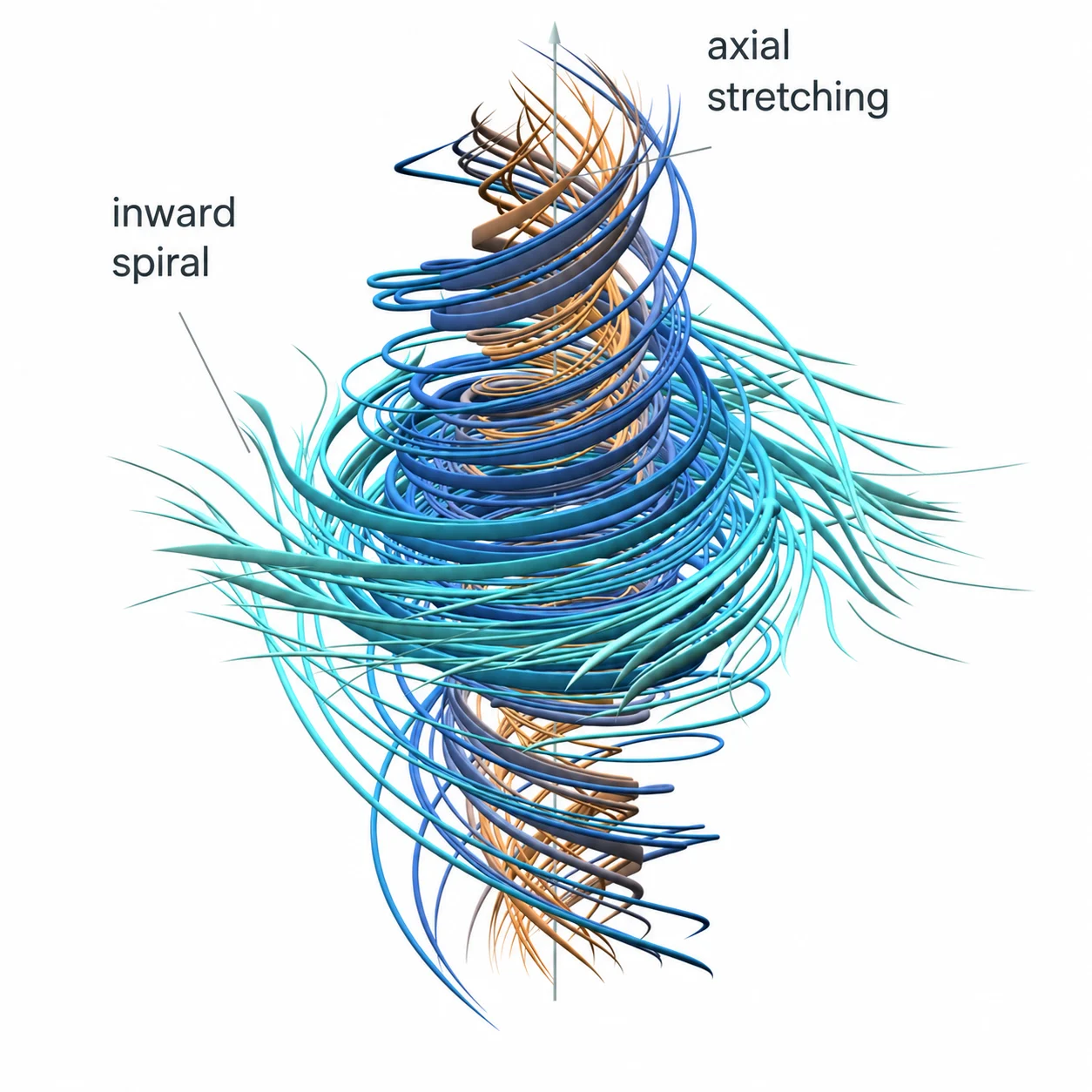
Maybe they don't write[^2] it specifically, but the post confirmed for me that it is [[Brute force|brute force]], but more interesting is how they do it:
> Agents were subdivided into groups with the ability to communicate within the group. The groups varied in size, and the group that produced the [[Navier-Stokes equations|Navier–Stokes resolution]] involved on the order of 10,000 concurrent agents.
>
> For the [[Navier-Stokes equations|Navier–Stokes problem]], we suggested versions “A” and “B” (particular forms of the [[Navier-Stokes equations|Navier–Stokes problem]] which would result in a proof) and versions “C” and “D” (which would result in a disproof) to separate groups of agents.
And how much it cost (in tokens):
> Across all attempted problems, the agents sent 4.9 million messages and used about 300 billion output tokens. In the process of resolving the [[Navier-Stokes equations|Navier–Stokes problem]], the agents sent 2.7 million messages and used approximately 130 billion output tokens.
It is quite a lot, and yes, it is great it can do it with actually limited (!) resources, but the question that stays for me is actually the profitability of it. It is similar to the [[Monte Carlo method]] (I know it is numeric instead of analytical), but the rise of computation (and better results) doesn't make the method efficient.
## Thinking vs working
People are afraid of AI being more and more [[Intelligence|intelligent]], whereas I find computation more and more capable - this is different, because there is still a human in the loop (who is actually [[Intelligence|intelligent]]) who gives instructions (or sets up the workflow), and the machine does it.
![[IBM Pollyanna Principle#^principles|IBM]]
And this is exactly what [[Notes/OpenAI|OpenAI]] did:
1. their researchers thought and defined an approach to find a solution
2. the agents executed that
This actually leads to the question whether [[Artificial intelligence|AI]] is actually a proper term, which [[Roger Penrose]] already raised:
![[Artificial Intelligence vs Artificial Cleverness#^penrose|AI vs AC]]
And I fully agree with it. And even rephrase [[Cleverness]] to [[Capability]]:
> Capable doesn't mean [[Intelligence|intelligent]].
Returning to the guy who wrote that we should "wake up":
1. first of all he completely misinterpreted what [[intelligence]] actually is,
2. then raised a fear - my question is what he actually fears.
[^1]: https://www.linkedin.com/posts/michal-wyrebkowski_kilka-dni-temu-napisałem-że-matematyka-została-share-7503165054943662080-WSO7
[^2]: https://openai.com/index/navier-stokes-solution/